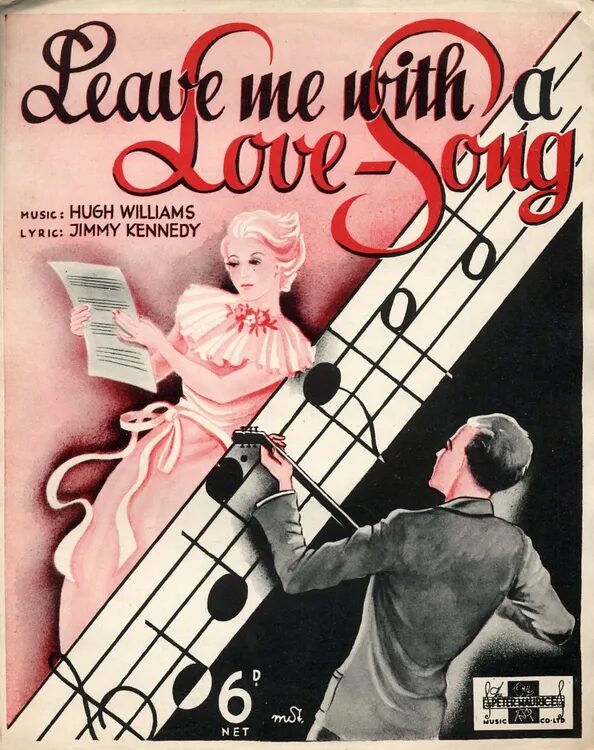
“Leave Me with a Love Song.” Music by Hugh Williams [Wilhelm Grosz], lyrics by Jimmy Kennedy. Recorded in London in September 1935 by Stan Atkins and His Band, with vocal chorus by Anne Lenner. Teledisk 1994 mx. S-281.
Much of what I have written about this record’s other side (“Red Sails in the Sunset”) is applicable to this side, as well; the tune even has the same songwriters. The disc itself is ridiculously rare,1 the band having been a less prominent one and the recording process that of a made-to-order disc company (Teledisk) rather than one of the more familiar companies such as Columbia or HMV that sold records to the general public.
As with “Red Sails in the Sunset,” we catch bandleader Stan Atkins providing Anne Lenner with a (presumably stock) arrangement of “Leave Me with a Love Song” that has not been suitably transposed into her vocal range. The vocal chorus is a challenge for Lenner and dips dangerously low, particularly at the beginning of the B part—but she succeeds in not sounding too gravelly. We have the sense that the recording session was arranged at the last minute.
I would not want to give the wrong impression by drawing too much attention to this deficit or others. The disc’s value lies precisely in its not being a representative of mainstream, high-end British recording technology and technique, but rather an unusual example of a less familiar band operating under imperfect circumstances and producing something nonetheless quite pleasurable. The resulting sides are a rare instance of Anne Lenner recording with a bandleader other than Carroll Gibbons, with whom her career was intimately connected. As it happens, “Leave Me with a Love Song” is perfectly delightful, and the foxtrot’s instrumentals are handled nicely by Stan Atkins’s anonymous band members.
“Red Sails in the Sunset.” Music by Wilhelm Grosz (under the pseudonym Hugh Williams), with lyrics by Jimmy Kennedy; composed for the Broadway show The Provincetown Follies (1935). Recorded in London in September 1935 by Stan Atkins and His Band with vocalist Anne Lenner. Teledisk 1994 mx. S-279.
For me, part of the pleasure of researching Anne Lenner is gradually discovering which of her recordings are comparatively difficult to acquire — and then wondering why. Surely music of such high quality should have sold millions of copies and ended up in everyone’s grandparents’ attic? But here we get into the vagaries of business decisions made by record executives, of the amount of pocket money the British public had to spend in a given year, of changing tastes — and even of the idiosyncrasies of my own taste.
What is not a mystery is such cases as the radio transcriptions of Anne Lenner providing vocal choruses for Carroll Gibbons and His Boy Friends on the 1934-1935 Hartley’s Jam programs, discs that are surely one of a kind and that are known only because Gibbons’s widow found them in his personal collection. I would be surprised if I ever end up in the same room as one of those precious, iconic records. This Saturday I was delighted, however, to be in the presence of, and even to get to digitally transfer, a record from a category described by the authoritative Mike Thomas as “horrendously rare,” viz. one of Stan Atkins’s 1935 Teledisks, of which only three are known to have been made (Atkins would later record four Deccas in 1944). This particular Teledisk was brought over to my house by its owner and my close friend, Henry Parsons. It was one that I had previously known only from a tape recording in the possession of another good friend, Charles Hippisley-Cox, and it is the only one of Atkins’s Teledisks to have Anne Lenner as vocalist (on both sides, as good luck would have it).
It is easy to understand why such a record would be so rare. As Mike Thomas explains, Teledisk was not a normal, commercial record company selling to the general public, but rather an operation that made discs to order. What is more, they did not employ the classic method of using wax to record their masters; rather, the sound of the band was recorded on aluminum discs and later transferred to shellac. And instead of wax being removed by the cutter, the aluminum is merely displaced, leading to an area between the grooves that can be inadvertently “played” — I got to experience this area’s bizarre sound myself, entirely by the accident of having placed the stylus in just the wrong spot.
To explain how Stan Atkins and His Band would have ended up make this Teledisk, instead of a normal, mass-produced record, we should consider that he was a comparatively obscure bandleader at the time. Atkins had taken up playing the drums after serving in WWI and had gone on to form a small band in 1929. By 1935, his band was just prominent enough to enter into a formal arrangement to fill in for Oscar Rabin’s band when the latter was on vacation.1 Atkins was years away from his later fame as a WWII-era broadcasting artist, and nearly a decade away from making a few conventional Decca records. So when we find Stan Atkins recording three Teledisks in 1935, we should probably understand them as part of an effort to drum up (ahem) interest in his band — perhaps he gave a few copies to record executives to listen to? It is hard to say.
The recording of “Red Sails in the Sunset” shows Atkins’s band to be surprisingly good, though I think I can hear a couple of moments when they falter. I wonder how they managed to get Anne Lenner to record with them? September 1935 was early in her recording career. I imagine she did not have any trouble working around her Columbia contract, as a Teledisk session would not have counted as a normal commercial engagement. But I do not get the feeling that Lenner had much time at all to work with the band.
To start with, as Henry Parsons pointed out to me, she misses her cue coming in near the beginning of the song. She likely did not get to rehearse with the band, and apparently there was not a preferable second take. Also, the key is entirely too low for her, and you can hear her skipping up an octave to finish the chorus. It would have been entirely possible to transpose the piece into a key more suited to Lenner’s range, but presumably time did not allow, and the need for such an adjustment might not have been foreseen. But as it turns out, the oversight in no way spoils the outcome: Lenner makes the octave shift and comes out sounding angelic.
A lot of what makes this Teledisk so desirable, then, is not that it attests to unusual virtuosity under ideal circumstances, but rather to great talent manifesting itself under the stresses of unusual circumstances: a rather good band whose members may not have been used to recording together (or recording at all), a first-rate vocalist perhaps brought in at the last minute (as a favor or as an act of friendship?), with time and budget limited. Hearing Anne Lenner record with someone other than Carroll Gibbons is a rare enough experience, and perhaps we can get a better idea of her individual talent as an artist when she is removed from the nearly perfect combination of Gibbons and the Columbia studios.
Chris Hayes, “Chris Hayes Remembers Stan Atkins,” Memory Lane 62; Worsley, Peter (Edmund Whitehouse, pseud.), This England’s Book of British Dance Bands from the Twenties to the Fifties, This England Books: Cheltenham, Gloucestershire, 2001, 91. ↩︎